Overview
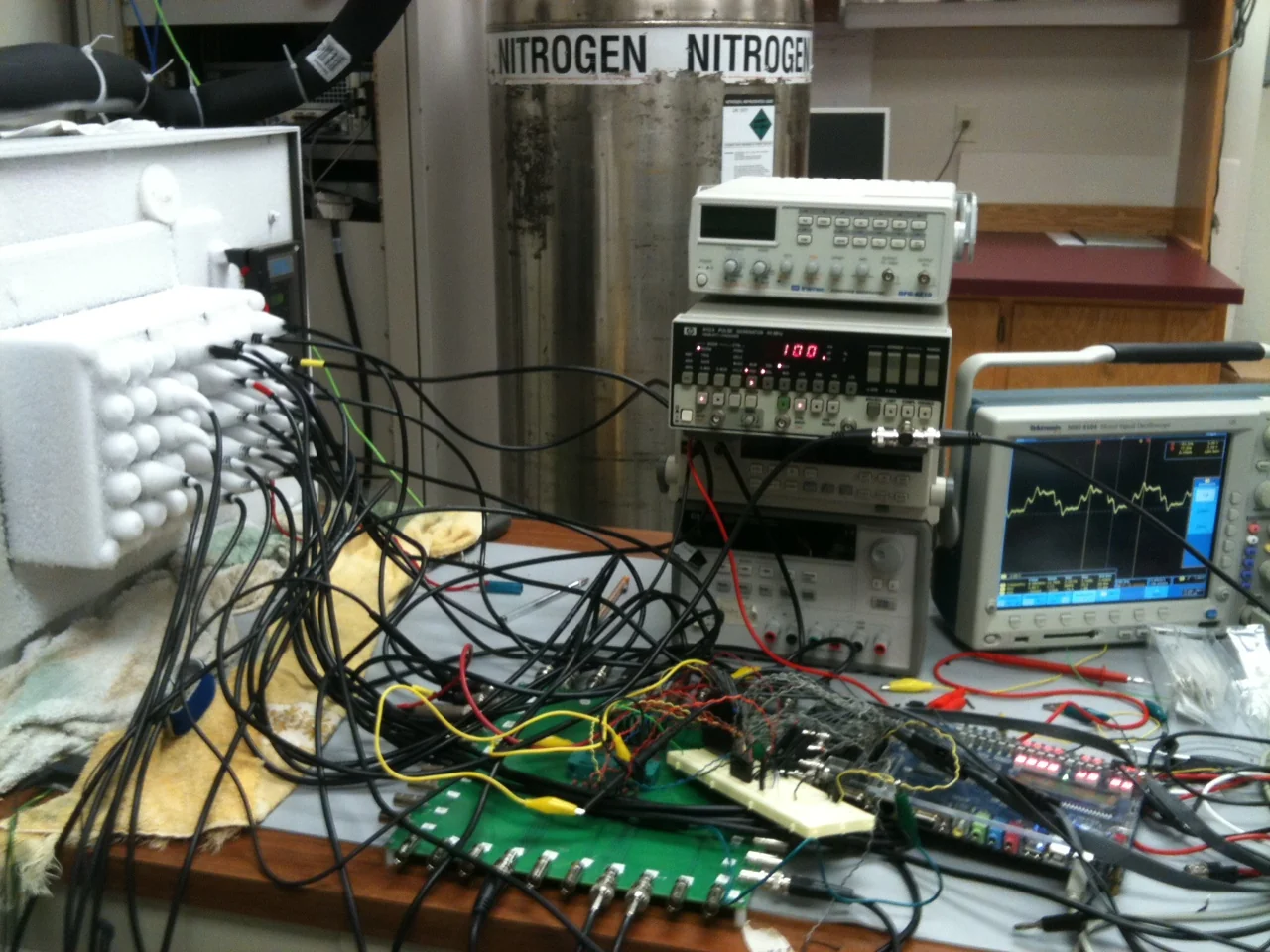
This research designed and executed a systematic reliability testing framework for embedded processors operating under extreme environmental conditions (-180°C to +125°C). An FPGA-based test harness automated the validation of two processor implementations, running each through a suite of correctness routines across six temperature points to surface failure modes and compare design robustness.
The core research question: can a clockless (event-driven) design architecture eliminate the class of timing failures that plague clock-driven systems when operating conditions change drastically?
The Problem with Synchronous Circuits
As temperature changes, several characteristics of a digital circuit vary:
- High temperature → reduced carrier mobility → slower circuit → setup time violations
- Low temperature → increased carrier mobility → faster circuit → hold time violations
Synchronous designs rely on fixed clock periods that must be conservatively sized to cover worst-case temperature, wasting performance in typical conditions.
Null Convention Logic Solution
Null Convention Logic (NCL) is a delay-insensitive asynchronous design technique that uses a four-phase handshaking protocol instead of a global clock. Because data completion is signaled by the circuit itself (not by a clock), NCL circuits are inherently tolerant of timing variations:
- Circuit speed varies with temperature, but operation is always valid
- No setup/hold violations are possible by design
Experimental Setup
The 8031 microcontroller was implemented in both synchronous and NCL-asynchronous versions. Both were tested on an Altera DE2 FPGA board at:
| Temperature | Condition |
|---|---|
| -180°C | Liquid nitrogen (cryogenic) |
| 25°C | Room temperature |
| 45°C | Elevated ambient |
| 85°C | Industrial spec limit |
| 125°C | Automotive spec limit |
An external program/data memory sent instruction codes to each microcontroller and executed a validation routine to verify correct operation.
Results
The synchronous design failed at temperature extremes, while the NCL design maintained correct operation across the full range, confirming the advantage of delay-insensitive designs for space and extreme-environment applications.
Publication
Sabado F. and Jia Di, “Comparison of Asynchronous and Synchronous Digital Circuits under Extreme Temperatures.” State Undergraduate Research Fellowship (SURF). May 2011.